

Note: This is the latest installment of “From Old Notebooks,” an intermittent series that uses old journals, notebooks, and unpublished writing to unpack my creative process, make sense of memories, and provide fodder for future free-write prompts. This post ends with a writing prompt about departing from one’s travel plans.
When I was nearing completion of The Vagabond’s Way early in 2022, I had to cut out several entries, since I’d written nearly different 400 mini-chapters, and by design the book (subtitled “366 Meditations on Wanderlust, Discovery and the Art of Travel”) could only fit one entry for each day of a leap-year.
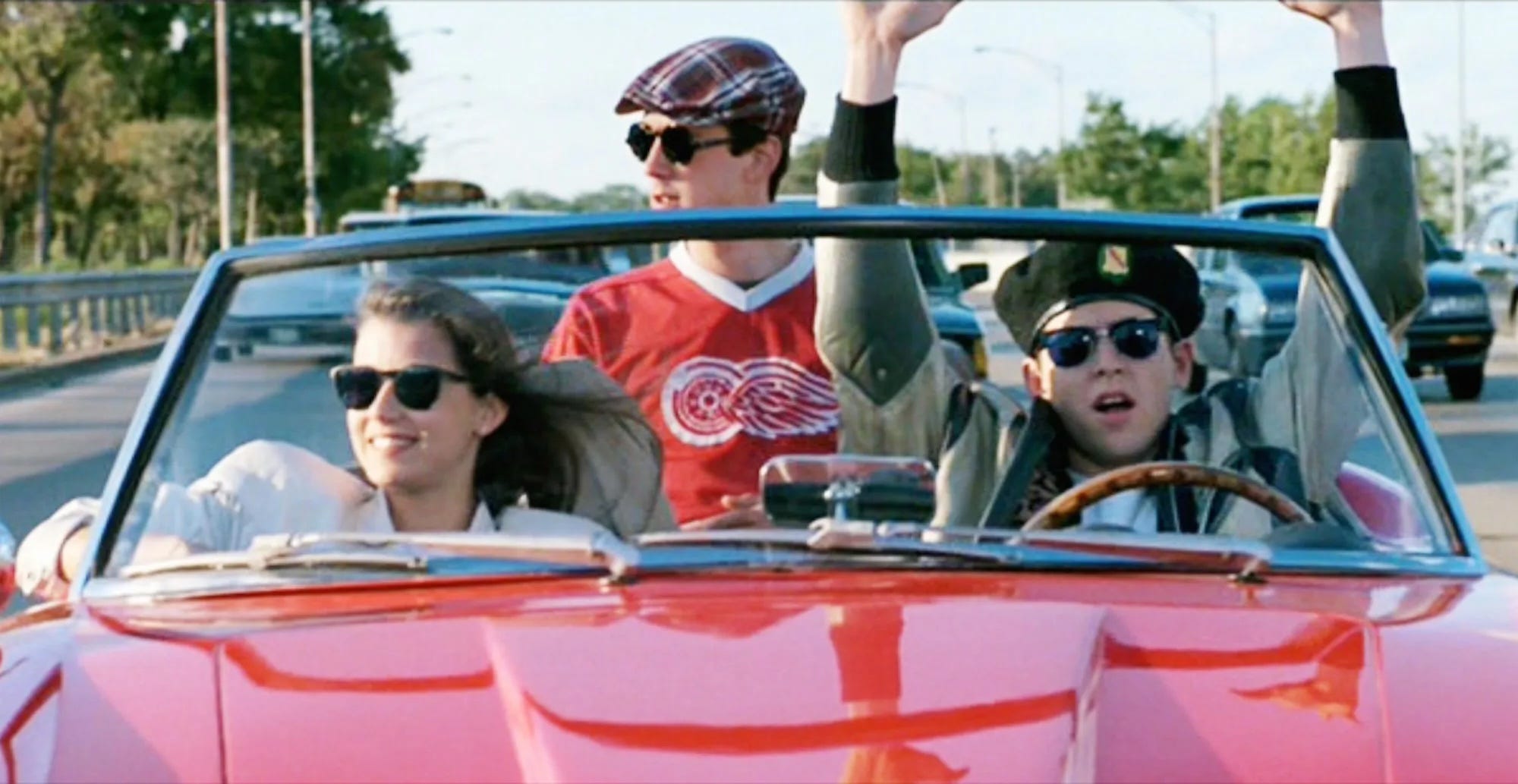
One of the toughest mini-chapters to take out involved the 1986 John Hughes teen comedy Ferris Bueller’s Day Off, which I’d characterized as a “close-to-home travel tale” about three suburban Illinois teenagers who skip school and spend the day wandering Chicago’s Loop district.
“Though much of Ferris’ urban adventure felt spontaneous and improvised,” I wrote, “Hughes’ original screenplay of the movie shows that Ferris put thought into what he might do that day. ‘A lot of people ditch school and feel great for about an hour,’ he declares in one early draft. ‘Then they realize there’s nothing to do. I myself have ditched and gotten so bored I did homework.’”
I continued:
Hughes’ script-draft didn’t depict the film’s protagonist sketching out a detailed itinerary, but it’s clear Ferris studied the city enough to know that the Sears Tower had a viewing deck, the Art Institute of Chicago was open to visitors, and the Cubs were playing a home baseball game that day. Ferris didn’t know exactly what he would do when he took his friends into the Loop, but he had researched plenty of options to draw from.
My book editor liked the spirit of this entry, but thought it was strange that I had quoted in an early draft of the Ferris Bueller screenplay rather than the finished movie. “The overall point of the entry is great,” she wrote in the margin. “But the fact that the early script draft included different lines feels unnecessarily complicated.”
My editor’s notation made me realize that she had a point (I ultimately took the mini-chapter out of the finished book) — but it also reminded me of how thoroughly Ferris Bueller had captured my imagination when I was young. Indeed, I hadn’t read the movie’s original screenplay online as a PDF decades after it came out; I had scoured my local library’s collection of bound screenplays in the late 1980s and read it on paper when I was still myself a teenager.
Unfamiliar with how finished movies differed from their original screenplays, I was amazed by how the script contained things that weren’t in the film. In addition to the way Ferris plans for the day (including a trip to the bank to withdraw money), the original incarnation of his character smokes lots of cigarettes, makes glib allusions to his bong, and takes his girlfriend Sloane and best friend Cameron to visit a strip club.
Every place can be full of possibility, if you’re open to it
I preferred the more wholesome version of Ferris Bueller that appears in the movie, in part because I liked the way he was portrayed as a friend to everyone at school. (“He’s very popular,” the school secretary declares at one point. “The sportos, the motorheads, geeks, sluts, bloods, wastoids, dweebies, dickheads — they all adore him. They think he’s a righteous dude.”)
Yet, trickster charisma aside, I loved the way Ferris treated his own hometown as a place full of possibility, making the most out of what the city offered him on that day. And, while the plot is firmly rooted in magical realism (most notably the German-American parade, when Ferris climbs onto a float and lip-synchs a Beatles song to the delight of the crowd), its quiet moments are as affecting as its triumphant ones.
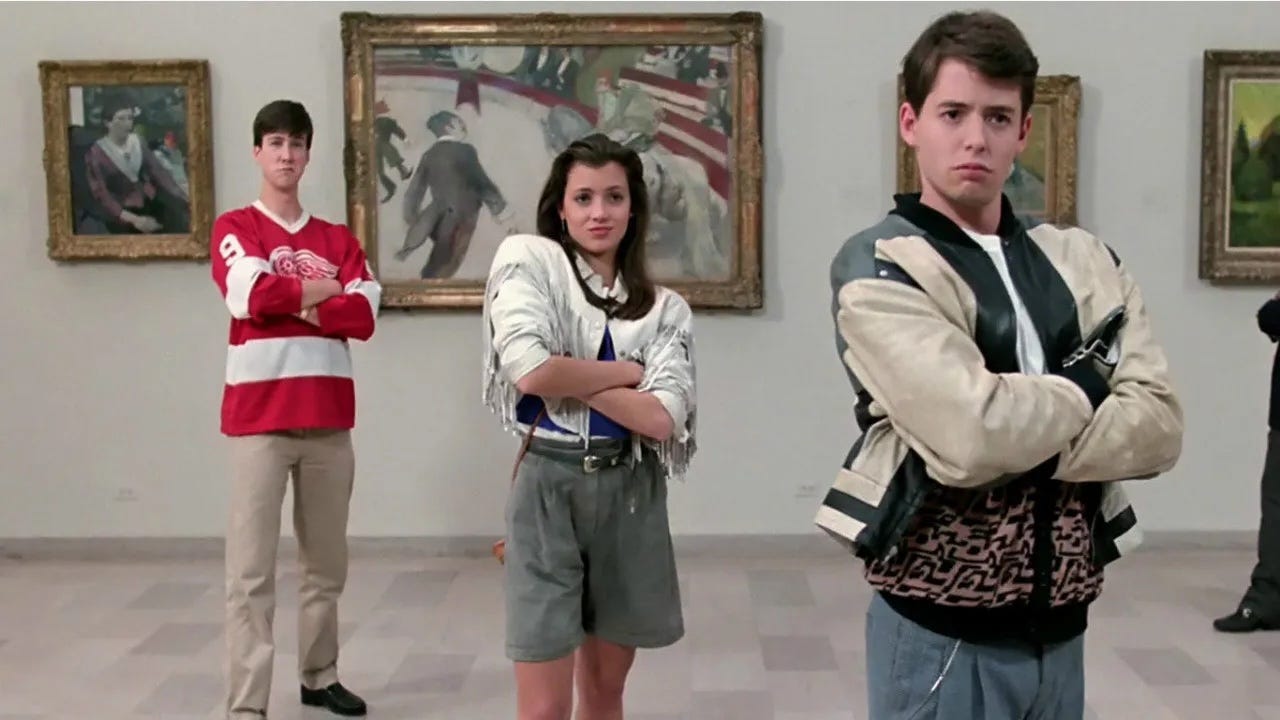
Indeed the sequence where the characters simply look at paintings at Art Institute of Chicago (Cameron somberly fixating on the pointillist details in Georges Seurat’s “A Sunday Afternoon on the Island of La Grande Jatte”) became so iconic that the museum now offers a 90-minute self-guided “Be Like Ferris Bueller” tour.
Years after having first seen (and loved) the movie, I’ve come to more fully appreciate the memento mori energy that underpinned Ferris’ travel ethos. “Life moves pretty fast,” he says early on, repeating the phrase again as the movie ends. “If you don’t stop and look around once in a while, you could miss it.” This insight manifests not just in the willingness to take the journey, but in the willingness to slow down and pay attention along the way.
As I wrote in the conclusion to my since-deleted Vagabond’s Way mini-chapter":
Sometimes the best approach to encountering a place is not to know exactly what you’re going to do there, but — like Ferris — have just enough of a plan to imagine its possibilities. In mixing what you know is out there with the willingness to take things as they come, you put yourself in a great position to let the adventure take you by surprise.
Free-write prompt
Make two lists on two pages. On the first page, list travel experiences that went exactly according to plan. On the second page, list travel experiences where the plan gave way to spontaneity. Brainstorm both lists for 15 minutes, listing as many travel experiences as you can think of. When the 15 minutes are up, asterisk the experiences that were the most satisftying for you. Which list had more asterisks? Pick one and write about that experience for 15 minutes, exploring what details (planned or unplanned) made it memorable.
The mini-essay above was the result of two 15-minute free-writes. It has been edited for clarity and context, but not formally revised. For more on the methodology of these free-writes, read my post, “How to exercise creativity in an age of algorithms.”
To experience a week of guided free-writes, flaneuring, and creative writing instruction in the most beautiful city in the world, consider taking one of my Paris Writing Workshops.
Big fan of Ferris Bueller here. (I've actually heard myself saying, "Bueller? Bueller? Bueller?" to a class of clueless middle schools students!) But I have to say I can identify much more with "early-draft" Ferris in terms of planning and spontaneity. I have an aversion to buying tickets in advance, but I like to know what my options are. While I leave lots of time for possibility -- of necessity and preference -- I also like, and need, to know the lay of the land. Great article. Can't wait to try the prompt. :)
It was a good film but I probably need to watch it again.